Austin Champ (1946–1960)
Introduction and Historical Significance
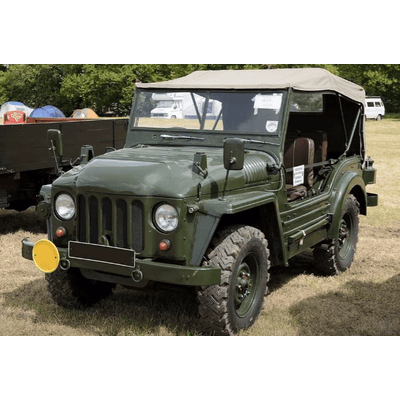
The Austin Champ was a British military vehicle introduced in 1946 and produced through to 1960. Originally designed as a general-purpose military vehicle, it was intended to replace the wartime vehicles like the Jeep. The Austin Champ was used by the British Army for various tasks, including reconnaissance, transport, and supply hauling. With its 4x4 capabilities, it could operate on a wide range of terrain, making it a versatile and valuable asset during the post-war period.
Designed by the Austin Motor Company, the Champ was heavily based on military specifications, including its all-wheel drive, robust frame, and high payload capacity. It was used extensively by the British military, as well as by other forces and organizations around the world, and was particularly known for its durability.
Technical Specifications
- Engine: 4-cylinder, 2.2L petrol engine
- Power Output: 72 horsepower
- Transmission: 4-speed manual
- Drive Type: 4x4 (four-wheel drive)
- Chassis: Heavy-duty, reinforced military frame
- Weight: Approximately 1,500 kg (3,307 lbs)
The Austin Champ’s engine and four-wheel drive capabilities made it a powerful and reliable vehicle for military use. Its design also included features such as a high ground clearance and strong suspension, allowing it to travel across rugged terrain without difficulty. Despite its military roots, the Champ was also adapted for civilian use after the war and became a popular choice for farmers and businesses requiring a rugged vehicle.
Variant Timeline
- Austin Champ Truck: The primary military cargo vehicle, used to carry supplies and equipment.
- Austin Champ Ambulance: A modified version designed to transport injured personnel in wartime.
The Austin Champ was produced in different variants to meet the needs of the military, with the standard truck version being the most common. The ambulance version played a crucial role in transporting wounded soldiers during combat, ensuring quick access to medical facilities in the field.
The Austin Champ in New Zealand
The Austin Champ was used in New Zealand primarily by the military and other governmental organizations. After the war, many of these vehicles were repurposed for civilian use. Its versatility, rugged design, and reliability made it a popular choice for farmers and small businesses who required a vehicle that could handle heavy loads and rough terrain.
Over the years, the Austin Champ has become a collector’s item in New Zealand, and several well-preserved models are now on display in vintage car clubs and museums. Its role in New Zealand’s history as a military and commercial vehicle has made it an iconic piece of motoring heritage.