Austin A30 (1951–1956)
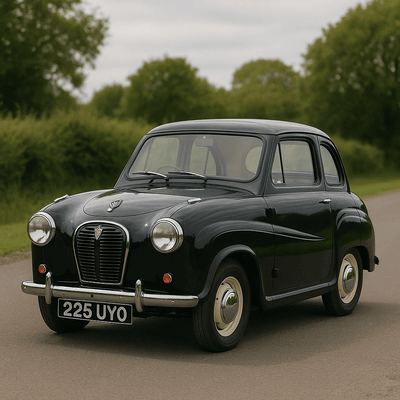
Introduction and Historical Significance
The Austin A30 was introduced in 1951 as a small, affordable family car, aimed at providing the growing middle class with an economical mode of transportation. The A30 was a successor to the Austin 7 and featured a more modern design, offering better comfort and performance. It quickly became popular in Britain and in international markets, including New Zealand.
The A30’s compact design, low cost, and reliability made it a staple of British motoring in the early 1950s. It was one of the first cars to make private car ownership accessible to a wider range of people, playing a significant role in the growth of the post-war automotive industry.
Technical Specifications
- Engine: 4-cylinder, inline
- Displacement: Approximately 803 cc
- Power Output: 30 horsepower
- Transmission: 4-speed manual
- Chassis: Compact, lightweight design for urban and rural driving
- Weight: Approximately 600 kg (1,323 lbs)
The A30's 4-cylinder engine was sufficient for the car's intended purpose: economical, everyday driving. Its lightweight design also contributed to excellent fuel efficiency, making it one of the most affordable vehicles to run in its class.
Variant Timeline
- Austin A30 Saloon: The standard closed-body version, most common in urban and rural markets.
- Austin A30 Van: A commercial variant aimed at small businesses needing a lightweight, reliable cargo vehicle.
The A30 was primarily available as a saloon, though a van variant was also produced for small businesses that required a dependable vehicle for transporting goods. Both versions were well-suited for the economic climate of the time.
The Austin A30 in New Zealand
The Austin A30 was a popular model in New Zealand, where its compact size and fuel efficiency made it an ideal choice for the country's mix of urban and rural environments. The car's affordability made it a practical option for families, and its lightweight nature made it well-suited for New Zealand's diverse terrain.
Many Austin A30s are still in circulation today, with collectors and vintage car enthusiasts preserving these iconic vehicles as part of New Zealand’s automotive history.